Attending: 1 | Spaces Left: 99
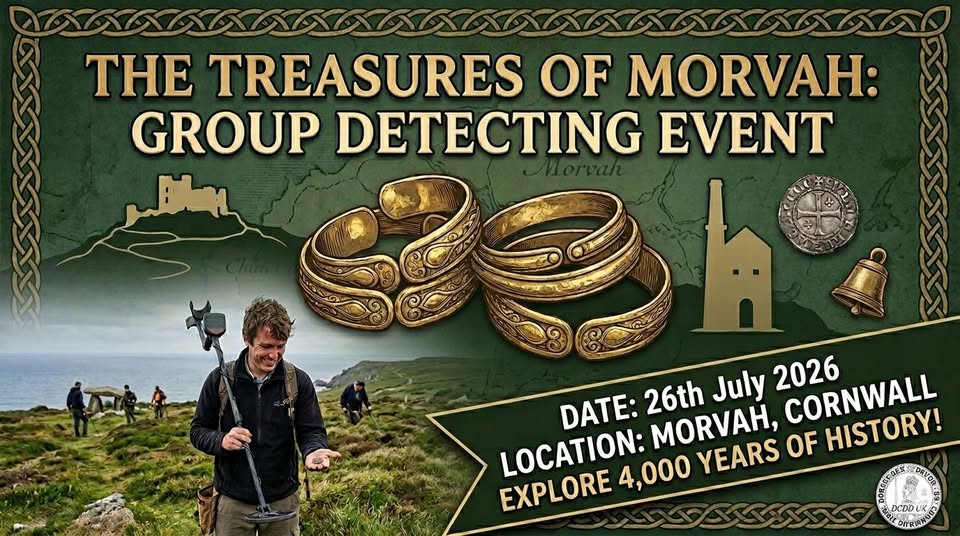
SUNDAY 26TH July 2026
This land is proven land and has never seen a detecting group on it before. Its one of my personal family permissions, there is lots of signal’s here, tons of Victorian and Georgian, has also produced roman and hammered coins.
The potential this place has for a significant find is amazing, I remember when I was a kid you could collect flint arrow heads eyes only when the fields were ploughed, all the fields we have fir this event will be grass just after cut.
The Treasures of Morvah:
A Journey Through 4,000 Years
To the casual passerby, the parish of Morvah is a quiet stretch of West Cornwall’s rugged Atlantic coast. But for those of us who look beneath the soil, it is one of the most significant archaeological landscapes in Britain. Nestled between the ancient strongholds of St Just and Zennor, the fields we are about to detect have been a hub of human activity since the dawn of the Bronze Age.
The Legend of the Morvah Gold-
The ultimate inspiration for any detectorist in this area is the Morvah Hoard. In 1884, while laborers were quarrying for building stone, they uncovered six magnificent gold armlets.
The Irish Connection:
Three of these bracelets were distinctly Irish in style, while the others were British. This suggests that Morvah was a vital trading post where Irish gold was exchanged for Cornish tin over 3,000 years ago.
Three of these bracelets were distinctly Irish in style, while the others were British. This suggests that Morvah was a vital trading post where Irish gold was exchanged for Cornish tin over 3,000 years ago.
Votive Offerings:
Many believe these weren’t just “lost,” but were ritual deposits hidden in the earth to appease ancient gods. While the originals are now in the British Museum, they prove that the “high status” finds in this parish are second to none.
Iron Age Power: Chûn Castle and the Giants
Dominating the skyline of our search area is Chûn Castle, a massive Iron Age hillfort built around 300 BC.
Many believe these weren’t just “lost,” but were ritual deposits hidden in the earth to appease ancient gods. While the originals are now in the British Museum, they prove that the “high status” finds in this parish are second to none.
Iron Age Power: Chûn Castle and the Giants
Dominating the skyline of our search area is Chûn Castle, a massive Iron Age hillfort built around 300 BC.
Continuous Occupation:
Unlike many forts, Chûn remained a seat of power well into the 6th century AD. Excavations have found evidence of small-scale tin smelting within its walls.
Unlike many forts, Chûn remained a seat of power well into the 6th century AD. Excavations have found evidence of small-scale tin smelting within its walls.
The “Tinners Way”:
An ancient trackway used for millennia to transport ore passes right through this landscape. Where there was trade and movement, there were lost items—from Celtic coins to early medieval brooches.
An ancient trackway used for millennia to transport ore passes right through this landscape. Where there was trade and movement, there were lost items—from Celtic coins to early medieval brooches.
Folklore:
Local legend says the area was protected by Holiburn the Giant, who lived among the carns. While we might not find giant bones, the “Giant’s Fields” surrounding the fort have seen thousands of years of foot traffic.
Local legend says the area was protected by Holiburn the Giant, who lived among the carns. While we might not find giant bones, the “Giant’s Fields” surrounding the fort have seen thousands of years of foot traffic.
The Medieval Heart:
Pilgrims and Pasty Days
At the center of the parish lies the church of St Bridget of Sweden. It sits within a circular “lan” (an ancient enclosure), suggesting the site was sacred long before the Vikings or Normans arrived.
Pilgrims and Pasty Days
At the center of the parish lies the church of St Bridget of Sweden. It sits within a circular “lan” (an ancient enclosure), suggesting the site was sacred long before the Vikings or Normans arrived.
The Morvah Fair:
Historically, the “Morvah Fair” was the biggest event in West Penwith. Held every August, it drew hundreds for wrestling, drinking, and heavy feasting. These gathering sites are traditional “hotspots” for finding lost coinage, buckles, and personal ornaments from the medieval and Tudor periods.
Historically, the “Morvah Fair” was the biggest event in West Penwith. Held every August, it drew hundreds for wrestling, drinking, and heavy feasting. These gathering sites are traditional “hotspots” for finding lost coinage, buckles, and personal ornaments from the medieval and Tudor periods.
The Industrial Frontier-
By the 1800s, Morvah was a landscape of industry. The ground here is scarred by the history of mines like Morvah Consols and North Levant.
Miners and Bal Maidens:
These fields were once crisscrossed by hundreds of workers every day.
These fields were once crisscrossed by hundreds of workers every day.
What to Expect:
Beyond the potential for ancient treasure, the industrial era provides a steady stream of finds: Victorian copper coinage, mining tokens (used as currency), ornate brass buttons, and crotal bells from the packhorses that once carried tin down to the sea.
Beyond the potential for ancient treasure, the industrial era provides a steady stream of finds: Victorian copper coinage, mining tokens (used as currency), ornate brass buttons, and crotal bells from the packhorses that once carried tin down to the sea.
Why This Site?
Detecting in Morvah is a rare privilege. Because so much of the parish is protected as “Scheduled Monuments,” having legal access to the surrounding farmland is a golden opportunity. We are walking on land that has served as a prehistoric cemetery, a royal Iron Age lookout, a medieval marketplace, and a Victorian industrial powerhouse.
Detecting in Morvah is a rare privilege. Because so much of the parish is protected as “Scheduled Monuments,” having legal access to the surrounding farmland is a golden opportunity. We are walking on land that has served as a prehistoric cemetery, a royal Iron Age lookout, a medieval marketplace, and a Victorian industrial powerhouse.
Detection Checklist:
Prehistoric: Look for “Ring Money,” bronze socketed axes, or flint tools.
Roman/Early Medieval: Keep an ear out for the thin signals of silver hammered coins or Roman “groats.”
Industrial: Watch for heavy brass artifacts and 19th-century trade tokens.
Every signal is a potential link to a story 4,000 years in the making. Let’s see what Morvah has been hiding.
